
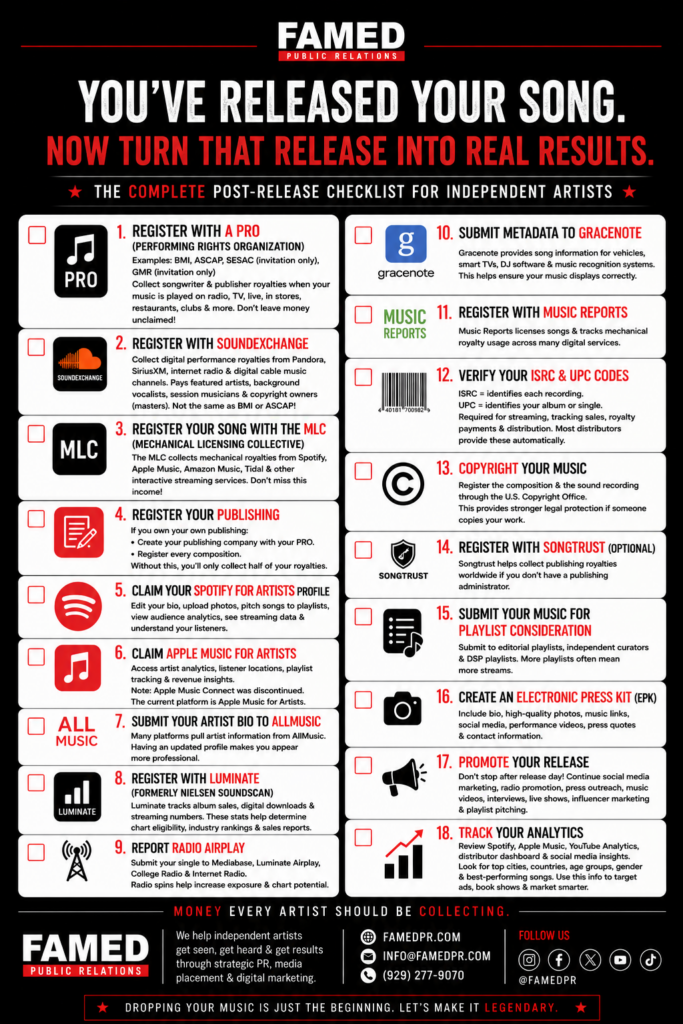
Releasing a song is not the finish line. It is the beginning of the work that turns a track into royalties, visibility, press coverage, playlist opportunities, useful data, and long-term career growth.
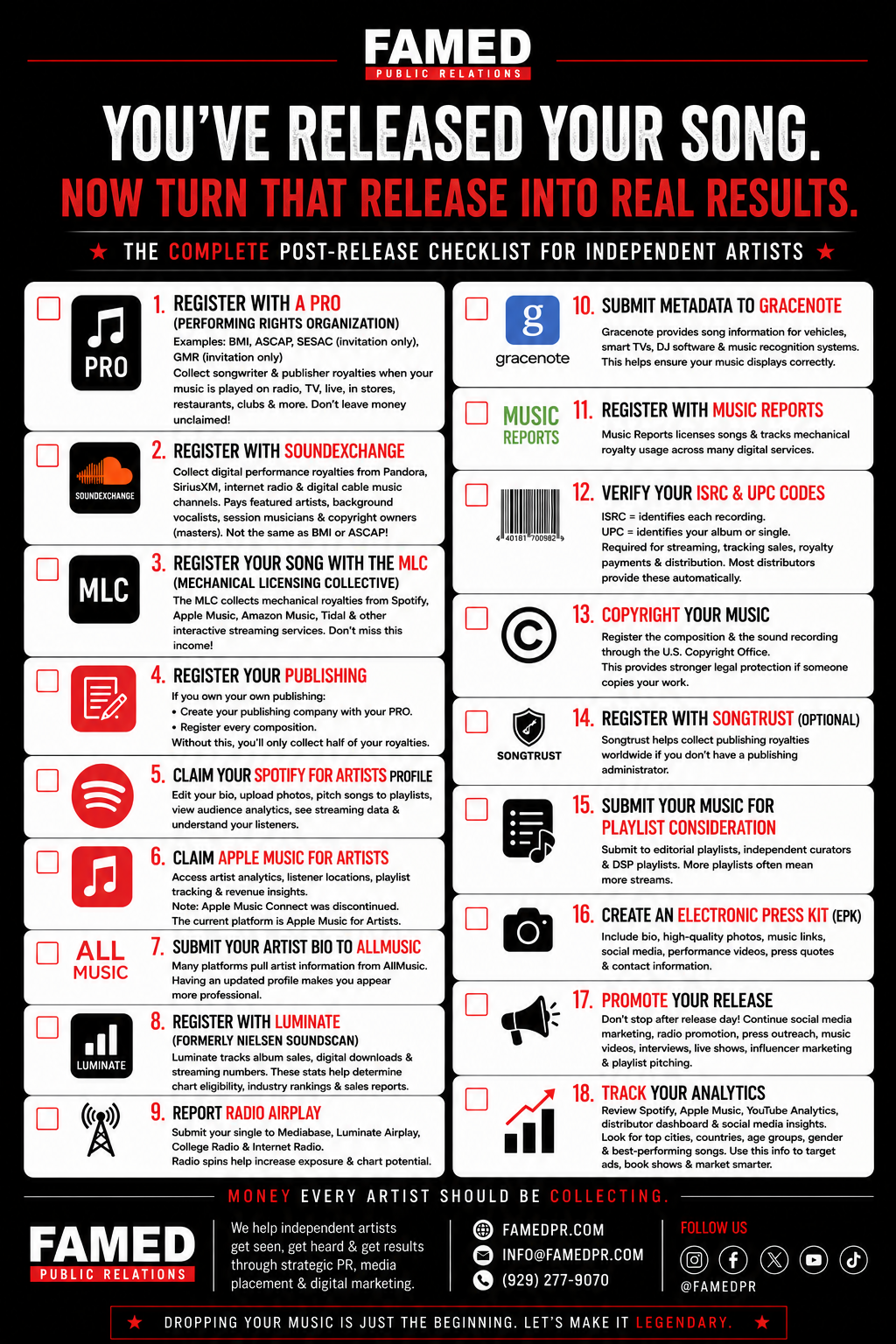
Many independent artists spend months creating a song, preparing the artwork, choosing a distributor, and announcing the release date. Then, as soon as the song reaches streaming platforms, the campaign slows down. That is one of the biggest mistakes an artist can make.
Uploading your music is only one part of the release process. The steps that follow determine whether the song is properly registered, whether royalties can reach you, whether journalists and curators take the release seriously, and whether the campaign produces useful momentum for your next record.
Important: Some steps are best completed before release, especially metadata verification and Spotify editorial pitching. If your song is already live, complete everything that still applies, correct mistakes quickly, and prepare earlier for your next release.
Use this 12-step post-release checklist: complete the business and royalty steps first, then strengthen your presentation, promotion, audience growth, and analytics.
1. Verify Your Metadata, Credits, ISRC, and UPC
Begin by checking all the information attached to your release. Confirm the spelling of your artist name, featured artists, song title, songwriter names, producer credits, publisher, label, release date, genre, explicit-content status, and artwork.
Inconsistent information can create duplicate artist pages, missing credits, delayed royalty payments, and confusion across streaming services. Your ISRC identifies the individual recording, while the UPC identifies the complete single, EP, or album release. Save both codes in a permanent release spreadsheet. Review the official IFPI ISRC information if you need additional guidance.
2. Register the Song With a Performing Rights Organization
A performing rights organization, commonly called a PRO, collects eligible public-performance royalties connected to the musical composition. These royalties may be generated when music is played on radio, television, at live venues, in businesses, and through certain licensed digital services.
Common U.S. organizations include BMI, ASCAP, SESAC, and Global Music Rights. Register the composition using the exact legal names and ownership percentages agreed upon by every writer. Keep a signed split sheet for your records.
3. Register the Recording With SoundExchange
Performing rights organizations and SoundExchange do not collect the same royalties. SoundExchange collects and distributes certain U.S. digital-performance royalties for featured artists and sound-recording copyright owners.
If you are both the performing artist and the owner of the master recording, register in both applicable roles. Search for your recordings, claim them, and verify that your artist name, ISRC, label, and ownership information are correct.
4. Register Eligible Songs With The MLC
Self-administered songwriters, publishers, and publishing administrators should review their eligibility for The Mechanical Licensing Collective. The MLC administers eligible digital audio mechanical royalties under the U.S. blanket mechanical license.
Create an account, search the database, register missing musical works, and claim your ownership shares. Verify every writer, publisher, percentage, PRO affiliation, and identifying number. A PRO registration does not automatically complete every other royalty-registration requirement.
5. Organize Your Publishing, Splits, and Copyright
Decide who controls the publishing share of the composition. Some independent artists create their own publishing company through their PRO, while others work with a publishing administrator. Before signing any agreement, review the commission, term, territory, services, ownership provisions, and cancellation conditions.
You should also consider registering the composition and sound recording with the U.S. Copyright Office. Keep your producer agreements, beat licenses, feature agreements, sample permissions, work-for-hire documents, and split sheets in one secure folder.
6. Claim and Improve Your Spotify for Artists Profile
Claim your official profile through Spotify for Artists. Add a professional artist image, update your biography, connect your social links, feature the new release, and confirm that the music appears on the correct artist page.
Review your listener data, saves, playlist additions, top cities, countries, and traffic sources. Spotify’s official editorial-pitching feature is intended for unreleased music. After release, focus on legitimate independent curators, fans, DJs, media outlets, creators, and tastemakers.
7. Claim Apple Music for Artists and Review Shazam Data
Request access through Apple Music for Artists. Update your profile image and artist details, add trusted team members when necessary, and study your performance information.
Apple Music for Artists also provides Shazam information. Shazam activity can reveal cities and countries where people are hearing your song. Those locations may be worth targeting through advertising, local press, interviews, appearances, and social content.
8. Correct Your Information Across Music Databases
Artist biographies, credits, images, and release information may appear in databases that provide data to music platforms, entertainment systems, media services, smart devices, and industry tools. Review your presence on AllMusic and learn about the official music-data services offered by Gracenote.
Use one approved biography, one official spelling of your artist name, accurate background information, and consistent credits. Consistency helps listeners, journalists, search engines, and platforms understand that your profiles and releases belong to the same artist.
9. Build a Professional Electronic Press Kit
An electronic press kit, or EPK, gives journalists, DJs, talent buyers, curators, and other industry professionals the information they need in one organized place. Include a short biography, full biography, streaming links, high-resolution photographs, artwork, producer and feature credits, social links, contact information, press quotes, and a clear description of the release.
Host the EPK on your official website or in a professionally organized cloud folder. Avoid oversized email attachments. A journalist should be able to understand who you are, what the song sounds like, why the release matters, and how to contact you within a few minutes.
10. Continue Playlist, DJ, Radio, and Media Outreach
Release day gives you a live link that journalists, DJs, curators, creators, and fans can immediately play. Build targeted outreach lists rather than sending one generic message to hundreds of recipients. Research every outlet, follow its submission instructions, and explain why your song fits its audience.
For radio, prepare the original version, clean edit, instrumental, performance version, artwork, ISRC, release date, contact information, and a concise one-sheet. Make it easy for a DJ or programmer to download, review, and properly identify the record.
For media outreach, lead with a genuine editorial angle. This could involve an unusual personal story, collaboration, regional movement, visual concept, cultural connection, milestone, charitable mission, or timely event. Simply announcing that you released a song is not always enough to earn coverage.
11. Create Several Weeks of Supporting Content
One cover-art post is not a complete campaign. Create several weeks of supporting content, including performance clips, lyric videos, studio footage, producer breakdowns, fan reactions, behind-the-scenes videos, live versions, interviews, visualizers, and explanations of important lyrics.
Each piece of content should give people a different reason to watch while keeping the song easy to find. Build recognition through a consistent visual identity, personality, message, and story. Ask questions, respond to comments, encourage saves and shares, and regularly direct people to the full release.
12. Track Your Results and Plan the Next Move
Review your distributor dashboard, Spotify and Apple Music analytics, YouTube performance, website traffic, social-media insights, email-list growth, press coverage, radio support, and advertising results. Do not judge the campaign only by the total stream count.
Study saves, repeat listeners, playlist additions, profile visits, follower growth, Shazams, top locations, referral sources, website clicks, and your best-performing content. These details show whether the campaign is developing a real audience or producing only temporary activity.
Review your results after seven days, 30 days, and 90 days. Record what worked, what failed, how much you spent, and which relationships require follow-up. A good campaign should make your next release stronger.
Frequently Asked Questions
How long should I promote a song after release?
Many independent campaigns remain active for four to twelve weeks. A strong video, interview, remix, performance, press placement, playlist addition, or viral moment can extend the campaign.
Can I pitch an already released song to Spotify editorial playlists?
Spotify’s official editorial-pitching feature is intended for upcoming unreleased music. After release, focus on legitimate independent curators, fans, media, DJs, creators, and your next pre-release pitch.
Do I need both a PRO and SoundExchange?
They administer different rights and royalty categories. Many independent artists require registrations with both, depending on their songwriting, performance, and master-ownership roles.
Should I copyright my song before or after release?
Registration timing can affect your legal options. Review the current instructions from the U.S. Copyright Office and consult a qualified music attorney for complicated ownership, sampling, or infringement issues.
What is the biggest post-release mistake?
The biggest mistake is disappearing after release day. Most listeners need repeated exposure before they remember a song or artist. Consistent follow-up creates more opportunities for discovery and long-term audience growth.
Your Song Is Live. Now Let FAMED PR Help People Find It.
FAMED Public Relations helps independent artists build professional release campaigns through music publicity, media outreach, editorial strategy, artist branding, digital promotion, and targeted exposure.
Start Your PR CampaignThis article provides general educational information and is not legal, tax, accounting, or financial advice. Royalty eligibility and registration requirements may vary by country, ownership structure, platform, agreement, and type of music use.

Natalia is a dedicated PR specialist, publicist, and journalist with a profound passion for the music industry. Her academic background includes a degree in Public Relations from The New School in New York and a journalism course at Michigan State University. Beyond her editorial responsibilities, Natalia organizes rap events and contributes to Wikipedia as an author and editor, focusing on hip-hop content. Residing in Miami, she is committed to discovering and promoting new talent, helping artists gain exposure through online marketing and publications.