
Many independent artists upload music to streaming platforms and assume that distribution alone covers every income stream. In reality, several royalty categories exist beyond the basic payout most artists see from their distributor dashboard, and missing even one of them can leave meaningful money uncollected over time.
Understanding how music royalties work is one of the most important long-term business skills an artist can develop. Songs can generate income from streams, downloads, public performances, broadcasts, physical formats, video placements, and more, but those payments are often handled by different organizations rather than one central company.
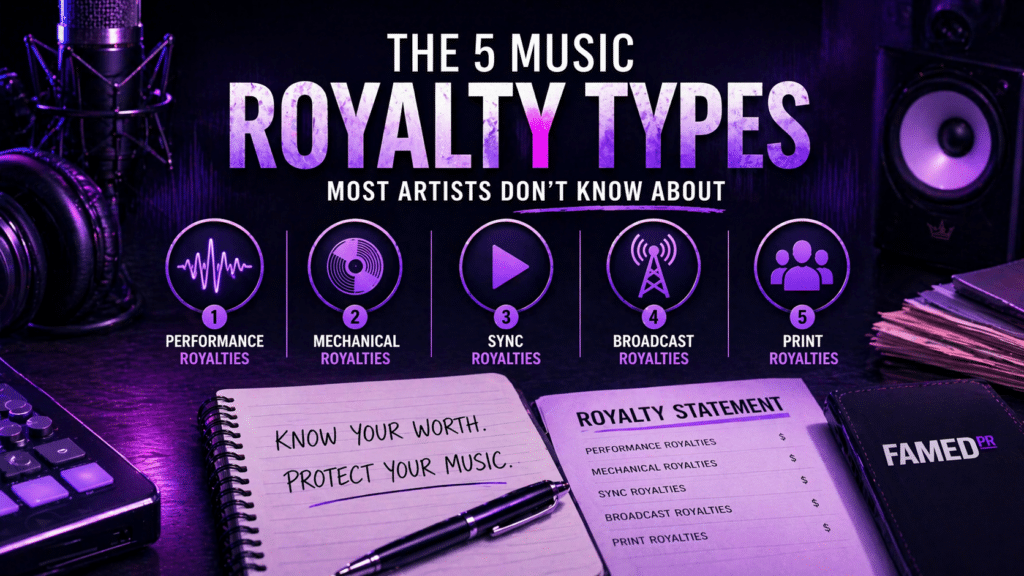
Below are five major music royalty types every independent artist should understand if they want to build a stronger and more complete music business. The goal is not just to release music, but to make sure every release is properly positioned to earn from every legitimate source available.
1. Performance Royalties
Performance royalties are generated when a composition is played publicly. That includes radio airplay, television broadcasts, live venues, restaurants, clubs, and digital streaming services that publicly perform music. These royalties typically go to songwriters and publishers rather than directly to the owner of the master recording.
For example, if your song appears on terrestrial radio, internet radio, a live venue playlist, or a televised sports segment, the composition side of that usage can generate performance royalties. In the United States, these royalties are commonly collected through performing rights organizations such as BMI, ASCAP, or SESAC.
Many artists sign up with a distributor but forget to affiliate themselves properly as songwriters with a performing rights organization. When that happens, the composition may still be generating value, but the artist is not fully positioned to collect what belongs to them.
2. Mechanical Royalties
Mechanical royalties are paid when music is reproduced or streamed. This includes interactive streaming platforms, downloads, and certain physical formats such as CDs and vinyl. While many artists have heard the term before, a surprising number still do not understand that mechanical royalties are separate from the standard distributor payout they see from Spotify or Apple Music.
- Spotify
- Apple Music
- Amazon Music
- Digital downloads
- Physical CDs and vinyl
In the United States, these royalties are commonly administered through the Mechanical Licensing Collective, also known as the MLC. Songwriters and publishers can register their works there to help ensure that eligible streaming mechanical royalties are properly tracked and paid.
One of the most common mistakes independent artists make is assuming their distributor automatically collects everything. In many cases, it does not. Distribution may handle master-side revenue, but that is not the same thing as collecting all composition-related income.
3. Master Recording Royalties
Master recording royalties are tied to the actual sound recording, not just the underlying song. These royalties are usually what artists think of first because they appear on reports from digital distributors. If you own your masters, this is one of the main revenue streams you will see from streaming and download platforms.
When your track is streamed on a major DSP, the master side is generally paid through your distributor or label arrangement. This is the income most independent artists recognize, but it represents only one part of the overall royalty picture. That is why artists who only focus on distribution often leave other rights uncollected.
4. Sync Royalties
Sync royalties come into play when music is placed in film, television, commercials, video games, social campaigns, or other visual media. Sync deals can involve an upfront licensing fee, backend royalties, or both, depending on the structure of the agreement and the type of placement involved.
If a song is licensed for a documentary, ad campaign, streaming series, or sports highlight package, the recording and the composition can both become part of the deal. That is why accurate ownership splits, metadata, and publishing registration matter so much. Without that foundation, even a strong placement can become messy or delayed on the payment side.
5. Neighboring Rights Royalties
Neighboring rights royalties are paid to performers and master rights owners when recordings are publicly performed in certain territories outside the United States. This category is often overlooked by independent artists, especially those who assume that domestic registration alone is enough to cover all international uses.
If your music is played on radio, television, or public systems overseas, neighboring rights can become relevant. Artists with growing international reach should pay attention to this area because global exposure can create income streams that do not automatically flow through the same channels as domestic streaming revenue.
Why This Matters for Independent Artists
The modern music business rewards artists who understand both the creative and administrative sides of their careers. A song can perform well across platforms, generate fan attention, and even build cultural momentum, but if registrations are incomplete or collection channels are missing, the artist may still be losing money behind the scenes.
That is why royalty education matters so much. Owning your music is powerful, but ownership only becomes fully valuable when your songs are properly registered, your splits are clear, and the right organizations know where to send the money.
Quick Poll
Which royalty type do you think independent artists miss most often?
If you want help making sure your music business is set up correctly, visit FAMED PR to explore artist services, royalty guidance, and music marketing support designed for independent releases.

Natalia is a dedicated PR specialist, publicist, and journalist with a profound passion for the music industry. Her academic background includes a degree in Public Relations from The New School in New York and a journalism course at Michigan State University. Beyond her editorial responsibilities, Natalia organizes rap events and contributes to Wikipedia as an author and editor, focusing on hip-hop content. Residing in Miami, she is committed to discovering and promoting new talent, helping artists gain exposure through online marketing and publications.